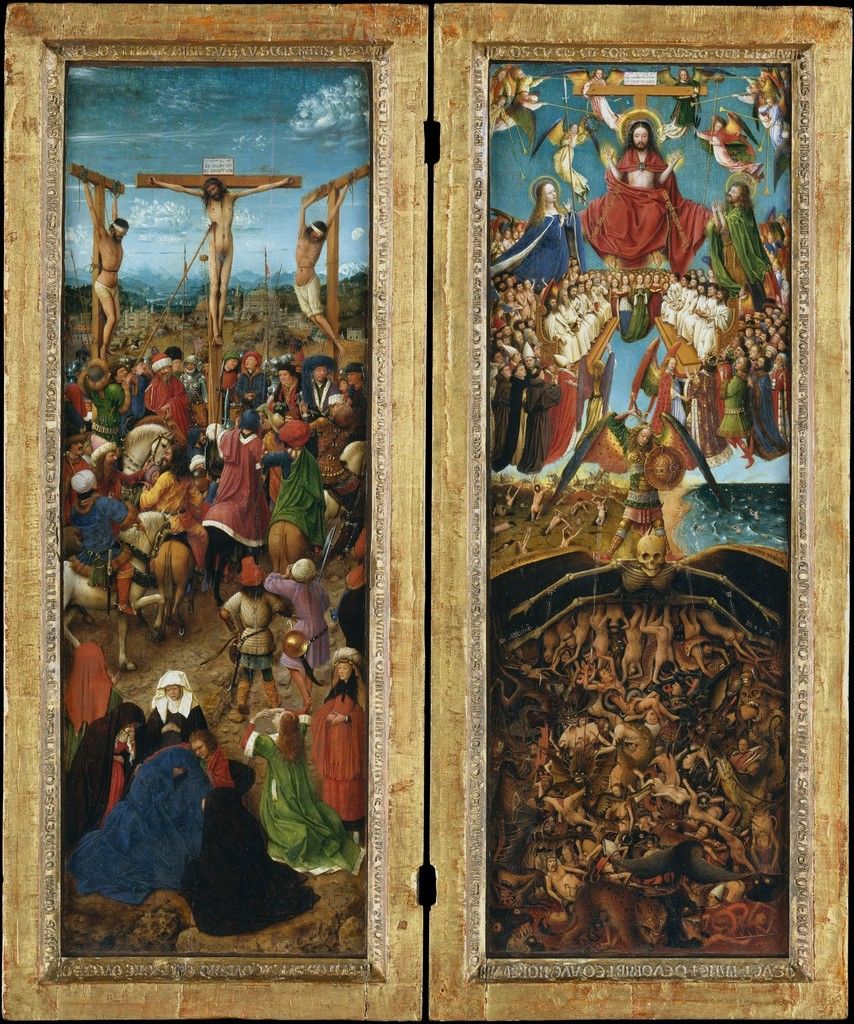
Both of these panels are full of absolutely astounding detail, and it’s difficult to see how much until you truly look at both panels thoroughly. On the left, you will see the crucifixion of Christ. If you look closely, the small city in the back is Jerusalem. Going down from the top you can see smiles on the men, or looks of indifference. There is a man in green with a fur-lined helmet that is actually stabbing Christ, and although you can’t fully see his face and whether he has a look of pain, indifference or even joy, it can strike a chord to see such violence portrayed even in just a painting. Going down further, you can see Christs’ followers weeping his crucifixion. I think this display of pure conflicting emotions displayed (happy or indifferent men participating or being watchers of Christs’ crucifixion, weeping, mourning followers of Christ) is meant to inflict emotion on those who look at it. The right hand side is portraying the Last Judgement. Going from top to bottom you see angels playing instruments and two people on either side of a now risen Christ. The people directly below him are saints, virgins, apostles and nobility. Going down even further, you can see the resurrected awaiting judgement, and even further down you see a hellish landscape of naked bodies being eaten by hellish creatures (The Crucifixion; The Last Judgment, ca. 1440–41). Although this oil painting seems a little morose, I would love to own this. The emotions Jan Van Eyck was able to elicit and the amazing detail he was able to portray in such a small frame is astounding.
Every time I look at it I notice something I didn’t notice before, which is what makes it so intriguing to me. How the light from Jerusalem is light blue with clouds, and the further it goes above Christs’ head it looks more and more foreboding with darker clouds, while in the other panel you can only see happy blue skies which is such a contrast with the hell-scape down below. Originally it was painted on 56.5 x 19.7 cm wide. The amount of detail painted into such a small space is quite astonishing (Van Eyck, The Crucifixion; The Last Judgment).
Jan Van Eyck was able to perfect the medium of oil painting, making him a prime example of a Humanist Renaissance artist (The Crucifixion; The Last Judgment, ca. 1440–41).
He also got paid very well for his paintings, which in turn caused him to give no mind to painting those who were needy or hungry, and instead painted what would appeal to the rich. This influence of royalty allowed his oil paintings to have heavy, rich colors as well as beautiful light colors that could make a crown to appear glowing, or nightmarish creatures look especially hellish (Cheryl Van Buskirk, 2018).
References
The Crucifixion; The Last Judgment,ca. 1440–41. (n.d.). Retrieved from https://www.metmuseum.org/art/collection/search/110000722
Van Buskirk, C. (2018). Jan van Eyck Paintings, Bio, Ideas. Retrieved September 26, 2019, from https://www.theartstory.org/artist/van-eyck-jan/#resources_header
Van Eyck, The Crucifixion; The Last Judgment. (n.d.). Retrieved September 26, 19AD, from https://www.khanacademy.org/partner-content/metropolitan-museum/82nd-and-fifth/observations/v/noise.

 Sarah's Blog
My first look I thought “wow”. It is amazing that all of this can be fit into one piece. The color, shading, and detail are great to look at. I am glad you chose pieces such as these.
I also used a piece by Van Eyck and he does like to use the idea of humanism to make himself known as a humanist renaissance artist. It is a great concept that he is able to grab ahold of and correlate it into his work.
I really enjoyed reading how in-depth you went with your description of the artwork? Where would you place this art if it was your own? Do you have a special place for art such as this one? It is a great work of art and glad that you shared it with everyone!
LikeLike