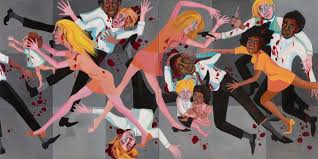
American People Series #20: Die
(1967) – Faith Ringgold
Photo taken from –https://www.moma.org/collection/works/199915
The Harlem Renaissance was a cultural movement during the 1920’s which aimed to gain equal rights amongst African Americans and Caucasians. During this time period, amazing pieces of work were being created to showcase the struggles, hard worked triumphs, and pain that accompanied such a time as this. One artist, Faith Ringgold asked herself, “How could I, as an African American woman artist, document what was happening around me?”. She was able to achieve the answer to this question by this work of art that is depicting racial relations in the United States in relation to riots happening all over the country. (MoMA). I know this picture is small and pixelated, so if you click on the link provided above you can gain more insight into my analyses through a clearer view of the mural. What first stuck out to me about this piece of art is the violence. When sifting through the art of this time, very little of it depicts such a horrific confrontation with the violent nature of what was happening. Looking closer at the photo, disregarding the blood splatter, guns, knives, and painful looks of the people, you will notice a black little boy and a white little girl holding each other, cowering. I also want you to notice the background of this photo. Although the clothes the men and women are wearing look business casual, this is not happening in an office or on the street. The place of this riot is ambiguous, and therefore left up to interpretation or subjective thought. Also notice the lack of variance in the clothes the people are wearing. The main thematic colors are a peach/orange, white, black, and tones of grey. The white women and black women are wearing the same dress, as well as the men wearing the same shirts and pants. These three things (the children holding each other, the place being left to interpretation, and the similarity and lack of variance) tells me something very specific about what Ms. Ringgold was trying to portray in the mural: 1.) this violence most likely perpetrated by those who wanted to have their grasp tightly held around racial inequality and white supremacy has an everlasting and traumatizing consequence on ALL children. 2.) Ms. Ringgolds choice to not show the background, or place where this riot was happening can give the overwhelming and scary thought that this can happen anywhere. No matter the supposed social class of the people, this violence was constant and no social class was immune. 3.) The lack of variance in clothes and between the same races tells me at least that no matter the person, social class, sense of morality or politics, everyone played a part. No African American was left untouched, and no Caucasian was left inculpable.

Picture taken from – https://americanart.si.edu/artwork/moon-over-harlem-11874
This oil painting depicts the Harlem Riot of 1943. A black woman was arrested for a supposed disorderly conduct. When a black soldier saw the woman getting arrested by a white officer, he intervened. The white cop shot and wounded Robert Brandy the soldier. After rumors circulated that the officer killed Brandy, riots erupted around Harlem specifically directed at white owned properties. It led to 6 deaths and over 600 subsequent arrests (Britannica). I chose this piece of art because it depicts a terribly hard truth. It is a confrontational story of a violence that is uncomfortable. “William H. Johnson based the pairs of figures at the left and right margins on photographs of rioters arrested by white officers. But Johnson painted the police as black men, and the ground is strewn with empty liquor bottles, as if the artist wanted to suggest that the people of Harlem were brutalizing themselves through their own behavior.” (Smithsonian American Art Museum). The black skyline, plain purple buildings, plain pink lamp all in the background show that the purpose of this oil painting is all in the foreground. Pay no mind or attention to what is happening in the background, the artist wants your full attention to be on the horrors that are happening in the foreground.

Picture taken from – khanacademy.org
This painting created by Jacob Lawrence is showing a Harlem street scene. Through the use of vibrant colors he is able to depict the Harlem community, even without showing the actual street or anything to symbolize them being in a neighborhood (Khan Academy). It may take a second to notice, but while this painting is full of vibrant reds, blues and yellows, it’s telling a story that is nothing less than horrifying. During the Harlem Renaissance, African Americans faced such depths of racial discrimination and systemic racism, it even stemmed into their quality of health care. Ambulances would arrive late to neighbors designated as “black neighborhoods”, and the quality of care was never assured. Also, notice how the man standing above/over the man in the gurney is an African American doctor. While it is possible the artist, Mr. Lawrence was trying to portray the only doctors that truly cared about African Americans being hurt were other African Americans, I think he was also trying to speak to another kind of inequality that wasn’t just an occurrence from random people, but also in the workforce. “Harlem Hospital was insufficiently staffed for the size of the local community and although the ambulance attendants and paramedic shown here are black, there were few job opportunities for African Americans in the medical field.” (Khan Academy).
Works Cited:
The Editors of Encyclopaedia Britannica. “Harlem Race Riot of 1943.” Encyclopædia Britannica, Encyclopædia Britannica, Inc., 25 July 2019, www.britannica.com/topic/Harlem-race-riot-of-1943.
“A Harlem Street Scene by Jacob Lawrence, Ambulance Call: Learning Resources.” Khan Academy, Khan Academy, www.khanacademy.org/humanities/special-topics-art-history/seeing-america/culture-and-society/a/a-harlem-street-scene-by-jacob-lawrence-ambulance-call-learning-resources.
Johnson, William H. “Moon over Harlem.” Smithsonian American Art Museum, americanart.si.edu/artwork/moon-over-harlem-11874.
Ringgold, Faith. “Faith Ringgold. American People Series #20: Die. 1967: MoMA.” The Museum of Modern Art, 2019, www.moma.org/collection/works/199915.


 Sarah's Blog
Great choice of works. I think the pieces you chose really portray the struggle and uncomfortable truths being confronted during the Harlem renaissance. I think all of the work you chose has an underlying current of abstraction that links them together just as the subject matter does, those these pieces were made by different artist they are almost coherent, as if they could have been painted by the same hand. It shows how much the artist of the Harlem renaissance really cared about justice.
LikeLike
Sarah, all of your painting are so raw that i can see them bringing out emotions to people. Your first painting is very raw and unpleasnt to look at, but its the subject thats not plesent more the anything. the fact the the artist uses just spatter of blood every where makes it to real for the veiwer witch make it a good painting.
LikeLike